
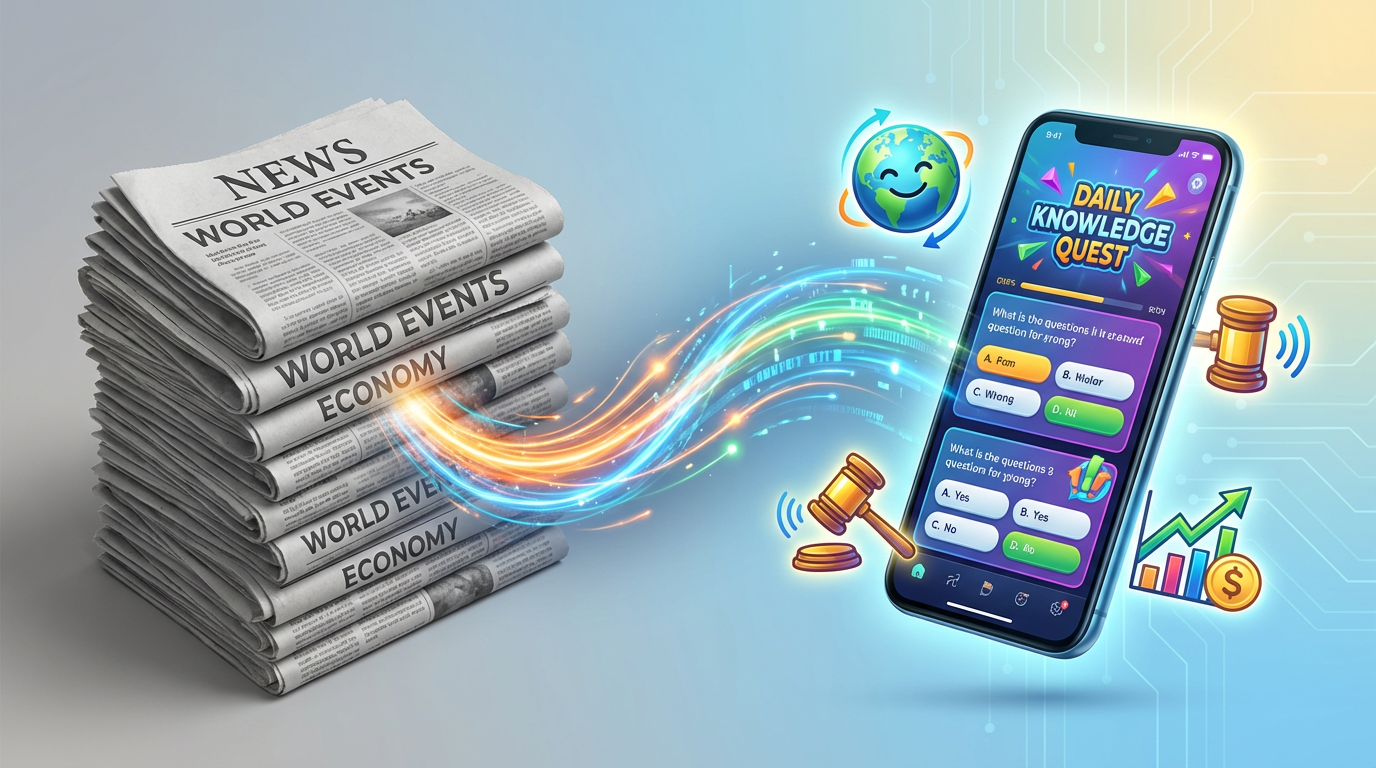
Let’s be honest: keeping up with current affairs can feel like a chore. We know it’s important, but our days are already filled with information overload. We scroll through grim headlines on social media, skim a few paragraphs of a dense news article, and by the next day, we’ve forgotten most of what we read. The news becomes a blur of noise, leaving us feeling anxious and uninformed.
What if there was a better way? A method that not only makes learning about the world genuinely fun but is also scientifically proven to make that information stick. The answer isn’t a new app or a complex reading system. It’s something simple, familiar, and incredibly powerful: the quiz.
It’s time to stop thinking of quizzes as mere trivia and start seeing them for what they truly are: the single most engaging and effective way to keep up with current affairs in the modern world. This article explores why a weekly quiz is the ultimate tool to transform you from a passive news-scanner into an active, informed citizen.
1. It Switches Your Brain from Passive to Active Mode
The fundamental flaw in how most of us consume news is that it’s a passive activity. When you read an article or watch a news report, your brain is in “reception mode.” It’s taking in information, but it isn’t being challenged to do anything with it. This is why facts and figures go in one ear and out the other.
A quiz flips this dynamic on its head. It forces your brain into “active recall” mode. When presented with a question, you can’t just sit back; you have to actively search through your mental database to retrieve the information. This act of searching and retrieving is like doing a bicep curl for your memory. It strengthens the neural pathway to that specific piece of knowledge.
Think about it: you’re far more likely to remember the name of a political figure if you successfully pulled it from the depths of your memory for a quiz question than if you simply saw it flash by in a headline. This active engagement is the difference between information washing over you and information becoming a permanent part of your understanding.
2. It Makes Learning a Reward, Not a Chore (Hello, Dopamine!)
Why do we enjoy games? A big part of the answer lies in a simple brain chemical: dopamine. When we achieve a goal or get something right, our brain releases a little hit of dopamine, which makes us feel good. This is the “reward” system that drives motivation.
Traditional news consumption rarely provides this reward. Often, it does the opposite, leading to feelings of anxiety or “doomscrolling.” A quiz, however, is a game. Every time you answer a question correctly, you get that small, satisfying rush of accomplishment. Your brain learns to associate the act of engaging with current affairs with a positive feeling.
This process, known as gamification, is revolutionary. It transforms learning from a duty into a desire. You start looking forward to testing your knowledge because it feels rewarding. Instead of forcing yourself to read dense articles, a weekly current events 2025 quiz can give you the key highlights in an interactive and enjoyable format that your brain will thank you for.
3. It Provides Context and Connects the Dots
The news we get from social media feeds is often fragmented and decontextualized. You see a headline about a trade agreement, then a story about a celebrity, followed by a local news update. The pieces are all there, but they don’t form a coherent picture. This makes it incredibly difficult to understand the “why” behind the headlines.
A well-designed current affairs quiz does the opposite. It naturally provides context. A good question isn’t just “Who won the election?” It might be, “Which policy promise was central to the winning campaign of [Politician’s Name]?” This forces you to connect people to ideas and events to consequences.
By grouping questions by topic (e.g., a round on the economy, a round on international relations), a quiz helps your brain organize information into logical categories. You start to see the relationships between different news stories, building a mental map of world events rather than just collecting a list of disconnected facts.
4. It Offers Bite-Sized, Memorable Learning
One of the biggest barriers to keeping up with the news is the feeling that it’s an overwhelming, time-consuming task. The thought of reading several long-form articles every day is daunting for most people.
A quiz breaks down complex global events into digestible, bite-sized chunks of information. Each question-and-answer pair is a self-contained micro-lesson. You learn a single, important fact in a memorable way. This is far more efficient than trying to absorb a 2,000-word article where the key takeaways might get lost.
This is particularly effective for learning and remembering specific data, like statistics, dates, or the names of key figures. The quiz format isolates the most important information and presents it in a way that is easy to process and retain. It’s the ultimate learning hack for the time-poor but knowledge-hungry individual.
5. It Sparks Conversation and Deeper Understanding
Perhaps the most underrated benefit of quizzing is its social power. While you can certainly do a quiz alone, discussing the questions with friends, family, or colleagues afterwards is where the deepest learning happens.
When you get a question wrong, what’s the first thing you often say? “Oh, I had no idea! Tell me more.” A quiz is a natural conversation starter. It provides a shared ground for discussing important topics in a fun, low-pressure environment. You might debate an answer, share different perspectives on a news story, or simply learn from someone else’s knowledge.
This social processing of information is incredibly powerful for memory and understanding. When you talk about a topic, you engage with it on a much deeper level than when you simply read about it. A weekly quiz can become a fantastic ritual for connecting with others and collectively making sense of the world.
Conclusion
In an age of information anxiety and passive consumption, the quiz emerges as a surprisingly powerful tool for active and engaged learning. It transforms a chore into a game, replaces fragmented headlines with connected knowledge, and turns a solitary activity into a social one. It leverages the science of active recall and the psychology of reward to make learning about the world not only effective but genuinely enjoyable.
So, the next time you feel overwhelmed by the news, don’t just mindlessly scroll. Seek out a well-crafted current affairs quiz. You won’t just be testing your knowledge; you’ll be training your brain, boosting your mood, and engaging with the world in a more meaningful and memorable way.
Frequently Asked Questions (FAQ)
1. How often should I do a news quiz to see benefits?
Consistency is key. A weekly quiz is a fantastic and sustainable habit. It gives you a regular opportunity to consolidate the past week’s events without feeling overwhelming. Doing it on the same day each week, like a Sunday morning, can help build a powerful routine.
2. What if I get a low score? Isn’t that discouraging?
It’s important to reframe your perspective. A low score doesn’t mean you’ve failed; it means you’ve learned a lot! Every wrong answer is an opportunity for your brain to form a new memory. See the quiz not as a test of your existing knowledge, but as an efficient tool for acquiring new knowledge.
3. Are all current affairs quizzes the same?
Not at all. Look for quizzes that provide context with their answers, explaining why the answer is correct. The best quizzes don’t just test your memory; they teach you something new with every question.
4. Is doing a quiz a replacement for reading the news?
It’s best to see it as a powerful supplement, not a full replacement. A quiz is an excellent tool for remembering key facts, figures, and events. However, reading a few in-depth articles on topics that interest you is still important for gaining a deeper, more nuanced understanding.
5. Can quizzes help me spot fake news?
Indirectly, yes. The more you engage with credible news sources through well-researched quizzes, the more you build a strong foundation of factual knowledge. This makes it much easier to spot information that seems “off” or contradicts what you already know to be true, improving your overall media literacy.